Manchester United’s 2025/2026 Premier League campaign so far can be characterized the same way as most seasons post the Sir Alex Ferguson era: inconsistent. As of December 10th, after a necessary win against Wolves, Ruben Amorim and Co find themselves on 25 points from 15 games, which slots them in 6th place. 7 wins, 4 Draws, and 4 Losses.
It really has been a real mixed bag of results. There have been games where you’ll think to yourself “Wow, this Manchester United team might actually have something this year.” Examples being the Liverpool, Brighton, and Chelsea matches. And others where you get brought back down to the reality that this team's inconsistency is a given. Examples of this being the Man City, Brentford, and Everton defeats. (Not to mention the Grimsby game in the Carabao Cup in which a League 1 side took them to penalties and won).
But what prevents them from going on a consistently decent run of performances? We know it’s been a yearly trend for years with this club, but what is it this season? This is where we reach Ruben Amorim and the way he sets up this team, with one of its biggest issues stemming from the midfield.
The Mischaracterization of Bruno Fernandes
Bruno Fernandes is simply not a traditional number 8. Will he put up consistent numbers season after season? Of course. In fact, the Portuguese international has reached double digit goals and double digit assists in every season since he joined the Red Devils. Will he come up with moments of magic by playing a killer pass, or going himself and slotting it home? Yes. Most definitely.
But in a midfield two, you need someone who is ultra tidy on the ball, who is disciplined and knows when to take risks and when to play it safe. Yet Bruno Fernandes remains in attacking midfielder mode.
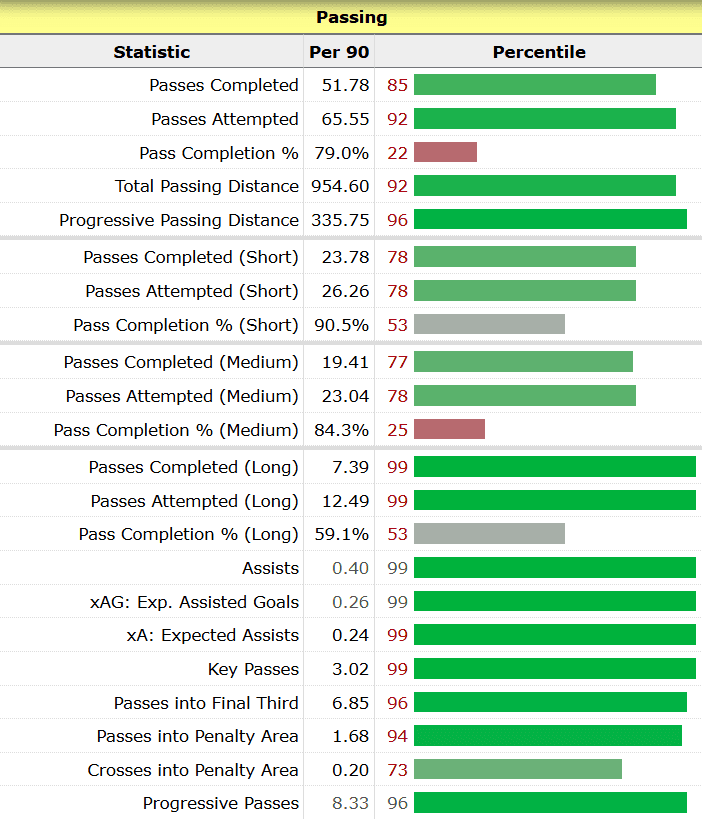
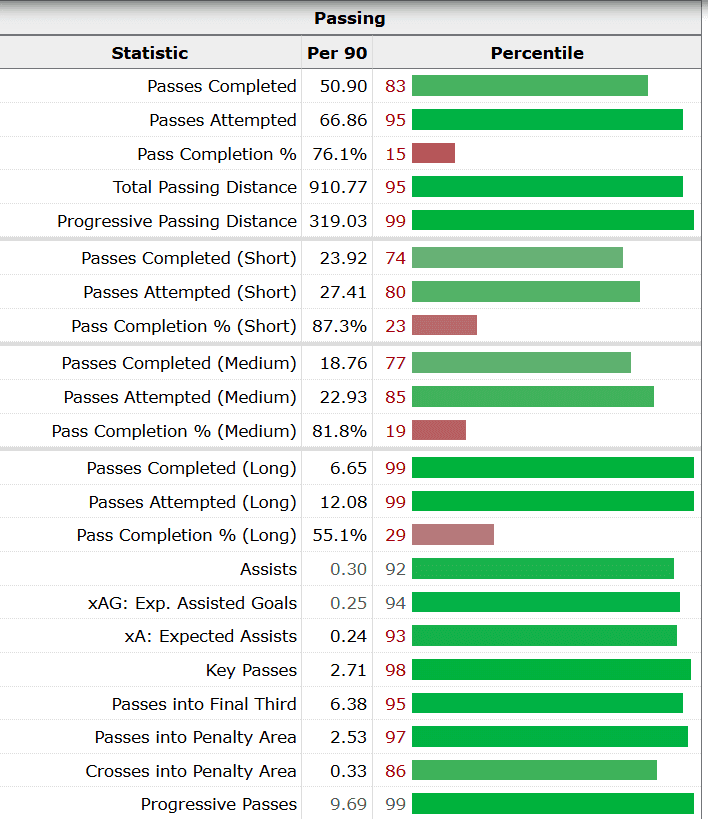
Bruno Fernandes Premier League ‘Per 90’ Passing Percentiles Bruno Fernandes Premier League ‘Per 90’ Passing Percentiles
2025/2026 2024/2025
Above, you’ll see two tables of Passing Percentile values from Bruno Fernandes in the Premier League. On the left you’ll find these stats are from 2025/2026, on the right 2024/2025. (It is important to specify that both sets of stats are being compared to other Central Midfielders. So even though in 2024/2025, Bruno primarily occupied the number 10 role, he is still being compared to central midfielders from that season).
For the most part, the tables are pretty similar in values. Other than Fernandes’s passing completion for both long and short passes improving enough to increase his percentile values by around 30, the 31-Year Old is still sitting at very similar percentile values in terms of passing between this season and last season. Even if you don’t look at the percentile values, just staring at the straight values, there isn’t really any relative difference in the amounts of passes he’s taking per 90 in the designated pass type, pass completions percentages, or passing distance amounts.
He’s still putting up attacking midfielder numbers in a midfield pivot, when frankly, with the way Ruben Amorim plays in his 3-4-2-1 formation, is not what is really needed from the 8. In the Premier League, having only two designated central midfielders in a pivot is already a huge risk. You are most likely already at a disadvantage in the middle of the pitch by not playing a midfield 3, with how fast paced and physical the flow of the games usually are. Not many teams can really pull it off, and it doesn’t help when half of your midfield partnership is unable to adjust to the position.
Bruno Fernandes himself in a recent interview with Prime Video Sport UK has talked about this indirectly. “. . .If my main feature is taking risks, the last pass, trying to assist, If I don’t do that I’ll become a useless player”, Fernandes claims.
He is 31-Years Old at this point, and for Ruben Amorim to create such a shift in his midfield responsibilities this late in his career was always going to be a risk. He is who he is, and he knows it. However, this change in responsibilities can also be seen as an unnecessary one, as Bruno Fernandes could easily play in one of the two number 10 positions and other players like Kobbie Mainoo (who many fans have vouched for this season), could be a more natural addition into the pivot. However, that idea at the moment is unknown.
The Complete Bypassing of the Midfield Two
Ruben Amorim’s 3-4-2-1 system is his signature, and it has a plethora of different quirks to it that make it his own. Two of these being its reliance on heavy involvement from the two wingbacks, and the reliance on a target man striker. However, these two premier features actually allow in most cases an underutilization of the midfield during ball progression
In terms of wingbacks, usually the pattern goes like this:
GK OR Central Defenders receive the ball and look to pass.
Wingbacks come down into space to receive the ball.
Wingbacks either look for quick one twos that allow for a quick break and space to run into OR they pass back which in theory allow the Central defenders to find another passing angle.
In terms of the Target Man, the pattern more often than not appears in the following way:
GK OR Central Defenders receive the ball and look to pass.
They either launch a long ball directly up towards the Striker, or they delegate that responsibility to other members on the pitch.
If successful, the Striker will have gained control of the ball, allowing for the two number 10s to run into space and open angles for a pass towards goal OR the striker will have at least gotten some contact on the ball, the Number 10s then recover the loose ball and drive at goal.
These two patterns of play have been what Manchester United have really relied on under Amorim this season, and they have definitely found them success against teams that allow them space for them to work. Liverpool, Brighton, etc. However, against teams who play a low block, or teams with a working press, these tactics become ineffective because then you need to rely on heavy possession, or more passing options in the middle of the pitch which requires your midfield two to possess the ability to get the ball, gain control, and keep the game ticking in your favor.
Against opposition like this, Manchester United usually fail to adapt. The midfield almost always is either swallowed up, or not even being fed the ball as they work on the wing, or through the air to the target man. Or even worse, they do get the ball, lose it and leave the back three with a bigger threat to deal with. This then prompts United to then just completely ignore the midfield two, go back to plan A and the cycle repeats itself. The football gets monotonous, with no signs of clear intent or clear vision and the system becomes predictable. Easy to read.
The midfield becomes a Plan C, when it really should be much more than just a backup option. The failure to fully implement the midfield pivot in Ruben Amorim’s system leaves the squad unable to break down most teams that are defensively competent, and is a big reason why the attack either is left stale or when multiple goals are conceded a game.
…
Ruben Amorim is under pressure to get results after heavy backing in the Summer transfer window, and the club’s failure to qualify for any European competition. And the way he sets up his team still leaves many fans split. However, he’s far from the first manager to find it hard to find consistency as the head of the Red Devils. And his midfield issues might be the reason he’s not able to break the cycle.