The road to joining the 40-man roster of an MLB team is changing. The bar for the chance of competing against the best talent in the world has not just moved up a rung, but morphed into an ever-changing labyrinth. Looking back just 5 years ago, the MLB drafting and recruitment process is completely different than what we see today, and the myriad of landmark decisions that have happened since then will change the way the MLB operates.
Before we dive in, let’s first set the stage of the MLB Draft.
The draft only allows Canadian or US, territories included, residents. These players must fall into one of the following categories: senior in high school, at least 1 year of junior college completed, completion of junior year of a 4-year college, or turning 21 while attending a 4-year college.
One can immediately tell the uniqueness of the MLB draft because of how restrictive it is. The NFL draft usually requires 3 years of college until eligibility, while the NBA draft just requires the athlete to be 19 during the draft’s calendar year. The above eligibility rules were explained in a couple of words, where it took a run-on sentence to detail what goes on in the MLB.
Now let’s take a look at different drafts. As of 2022, the MLB draft is 20 rounds and the number of draftees hovers around 615 across the board. This is nearly 3 times the size of the NFL draft and 10 times the NBA draft. Such excessive differences are not explained by roster size: the NBA has 15 players, NFL 53, and the MLB sits at 40. Instead, we must understand the farm system that professional baseball has created.
Every MLB team has 4-5 minor league affiliate teams, each with rosters of a couple dozen players. This means there are thousands of professional baseball players under contract with one of the 30 MLB teams. Baseball needs this unique style of player development because it is an extremely precise sport; baseball players are largely developing individual skills that take decades to hone. There also exists a massive gap between pro and college play, with college players swinging metal bats for 56 games each season, and those that are drafted are in for a rude awakening as the pop from a metal bat is replaced with a heavy wooden one, and the schedule is nearly tripled to 162 games a season.
Another facet of baseball is that it is no-contact, so unlike basketball and football, physical injuries from playing the game are not necessarily expected. The injuries that do occur, mainly Tommy John (UCL) surgery for pitchers’ elbows, are the result of over-exertion. A consequence of the design of baseball is that players can have much longer careers as compared to much more physical sports. Looking at rough averages, an NFL player could see 3 years in the league while an NBA player would have 4 to 5 seasons, but baseball players play up to 6 seasons on average. For the elites, the NBA has 11 players who have played at least 20 seasons while the MLB has 175 players with at least 20 years under the belt.
It makes sense that the MLB places so much emphasis on finding the top talent and forcing new drafts to endure years in minor league systems, because professional baseball players are long-term investments.
The process of going pro in baseball places immense pressure on young athletes as they are forced to choose from several life-changing options, from years of minor league development straight out of high school to fighting through college for more security in their futures. Each decision takes years to come to fruition, and now the correct choice is becoming even more blurred.
2014 O’Bannon v NCAA ruled in favor of UCLA power forward Ed O’Bannon, who represented all NCAA D1 football and basketball players, citing antitrust violations of the NCAA. The NCAA was ordered to allow colleges to give full-ride scholarships to athletes.
2019 saw the introduction and signing of California’s Fair Pay to Play Act, which allowed college athletes to market themselves with endorsements and sponsorships while continuing membership with the NCAA.
2021 Alston v NCAA and its decision was the result of student athletes’ collective anger over the NCAA’s restrictions of education-related benefits. This was followed by House v NCAA that required the NCAA pay $2.8 billion for former athletes, scholarship distribution changes, and direct revenue sharing between university and student athletes. The last point is most commonly referred to as name, image, and likeness (NIL) rights for a player.
These massive legal precedents have fundamentally changed the way athletes view college, because there is now constant cash flow that can directly go to players. However, these NIL deals and shared revenues really only benefit football and basketball players. Looking at college sports teams from the Power 4 Conferences (SEC, ACC, Big Ten, Big 12), by average revenue allocated per team from the revenue sharing, football takes 75.0%, basketball 16.0%, and baseball a meager 1.8%, or $365,000 for the entire team. Although collegiate baseball lacks popularity, a key settlement from House v NCAA, which followed directly from Alston, increased the scholarship limit for baseball from 11.7 to a full-roster 34, and this kicks in starting in the 2025-2026 season.
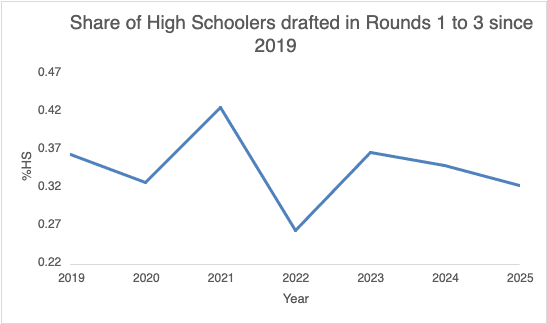
So, how has the MLB draft been changed? Well, it depends on where you look. Looking at the true elite talent, there hasn’t been much change in these high schoolers who elect to skip college, because their signing bonuses are often in the multi-millions.
Data from Baseball Almanac
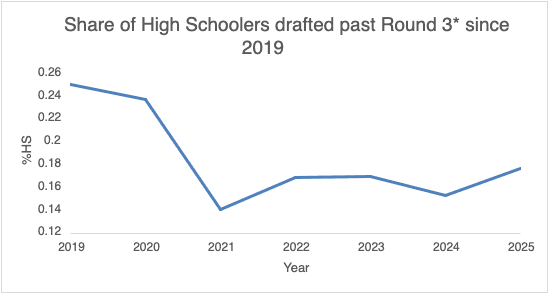
However, since 2019, the share of high schoolers electing to enter the MLB draft who are chosen past the third round has plummeted almost 10 points and stayed at these lower levels year over year. Over the past seven years, the average signed bonus for players drafted in the first round has jumped almost 43% from $3.04 million to $4.33 million, while the bonus for those drafted in rounds 2-5 has increased by nearly 32% from $739k to $972k. Interestingly, the largest gainer by magnitude has been the bonuses for rounds 6-20, which have seen a 50% increase. Although these bonuses are quite literally millions of dollars less than the top talent pool, there seems to be mounting pressure on the MLB to cough up more cash for all ranges of talent.
Data from Baseball Almanac
This could mean the MLB is aware of the massive changes currently underway in the collegiate system. So more money is being offered, especially for “role” players, because more power is being placed in the hands of these young athletes. One, college play has grown more elite in recent years because of the increase in money as well as the huge influx of statistical measures and data being analyzed such as the adoption of Doppler radar technology through TrackMan in 2010. This means players that elect to enter the draft after having done college ball are better than their older counterparts and thus demand more pay. Or two, the MLB is beginning to see collegiate baseball as a challenge, since NIL deals allow for top-talent names to gain recognition and sponsorships they would not be able to access had they been drafted and started their boot camp in the minor leagues. Young athletes have seemingly been handed more control than ever before, as the road to the big leagues becomes ever more confusing.
Since collegiate baseball generates much weaker revenue than basketball and could be mistaken as a margin of error for football revenue, programs apart from a strong NIL collective will benefit greatly in the coming years. This gives high school prospects a difficult decision, as it becomes increasingly more difficult to get into a top college program, let alone make it in the MLB minors. As top-talent is funneled through ever expansive money making machines, decisions in MLB teams’ top brass must be made about how to allocate spending because now, they aren’t just competing with each other, as pre-professional individual branding is here to stay.
Regardless of reason, the MLB has been forced to respond to unprecedented changes to their draft system to ensure future success. Things like the 2023 pitch clock change sped MLB games up, and a reduction of draft size from 40 rounds in 2019 to 20 in 2021 have been reflections of a modernizing product. It’s not just league-wide rule changes either. Former head coach of the Tennessee Volunteers Tony Vitello became the first MLB manager in history to have zero major league coaching experience as the San Francisco Giants hired him to manage the next 2025-2026 season. Vitello comes from the SEC conference, a powerhouse of D1 athletes that commands large swaths of NIL deals and opportunities for its athletes. As of 2025, 8 out of 10 of the highest paid head coaches guide SEC schools, with annual salary ranges from $1.45 mil to $3.35 mil.
The next several years will be extremely interesting for all levels of baseball as we are witnessing many different, but all equally historic, changes to what was once known as America’s favorite pastime.