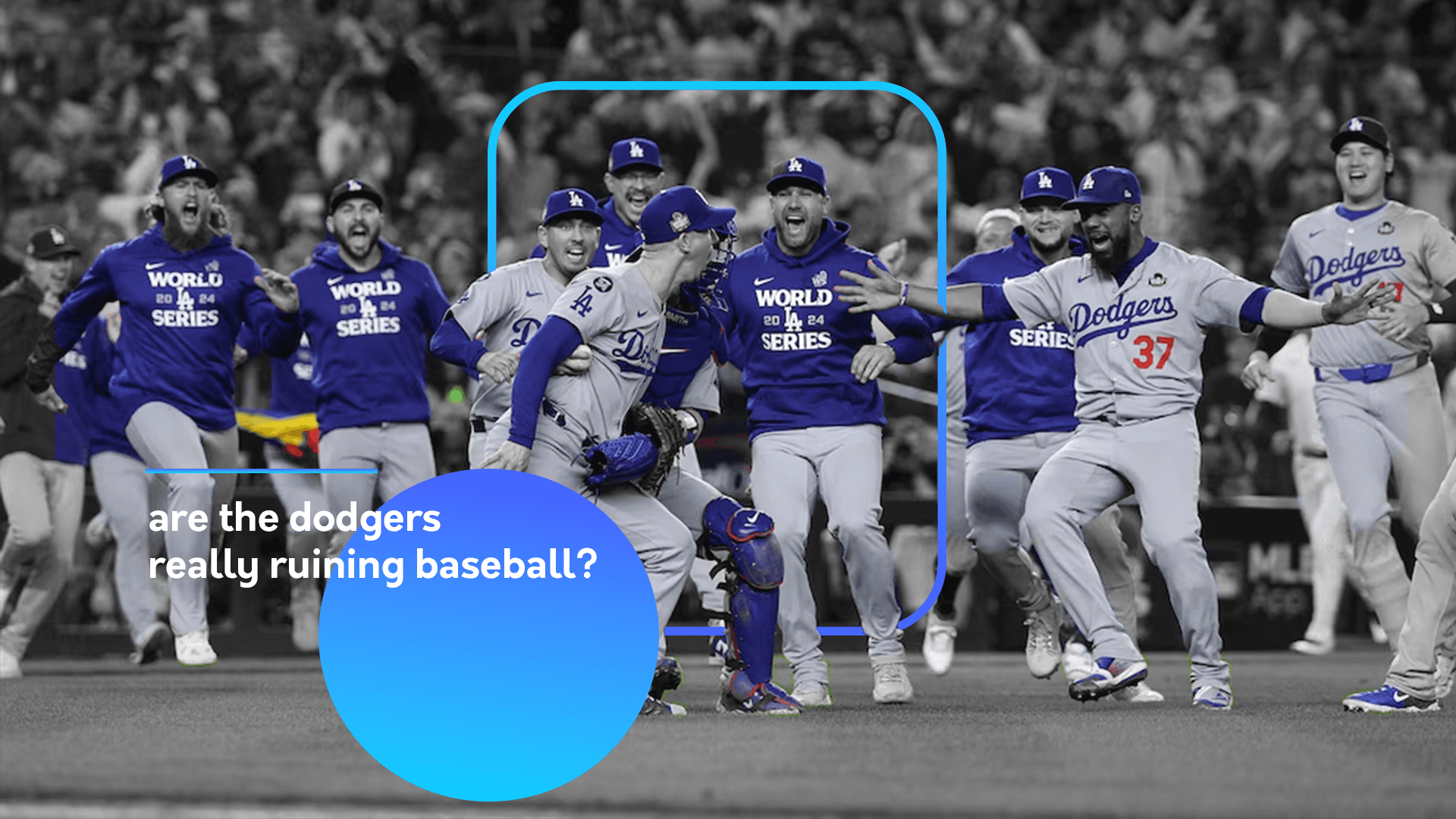
In October 2025, after sweeping the Milwaukee Brewers 4-0 in the National League Championship Series, Los Angeles Dodgers manager Dave Roberts said in his postgame interview that winning the World Series would let the Dodgers “really ruin baseball”. The idea that the Dodgers are "ruining baseball" has become a popular complaint in recent seasons, especially as the Dodgers have just won back to back World Series titles and favored to win a third straight World Series in 2026. To be fair, the idea about the Dodgers "ruining baseball" by “buying championships” is not totally unreasonable, as the Dodgers are one of the most valuable and profitable MLB franchises led by one of the wealthiest ownership groups, play in one of the largest US TV markets, and have a team made of up many former MVP and All-Star players. Additionally, the main complaint that many fans have with the Dodgers is extremely high payroll of $350 million, which was the highest in 2025, and has allowed them to acquire several top players through free agency in recent years, for example Shohei Ohtani, Yoshinobu Yamamoto, Blake Snell, and Freddie Freeman. However, though it is easy to criticize the Dodgers for their heavy spending, the idea that the Dodgers are “ruining baseball” could not be further from the truth. Instead, the problem lies with owners of small market teams who are unwilling to pay their players or invest in their team and simply treat their team as a way to make more money for themselves.
While many of the Dodgers’ players were acquired from free agency or trades, we first need to examine how exactly the Dodgers got them. Star players like Mookie Betts and Freeman were acquired through a trade and free agency respectively after their previous teams, the Red Sox and the Braves were unwilling to pay them their full value. During Ohtani and Yamamoto’s free agency, their contract offers from the Dodgers were matched by other teams like the Blue Jays and Giants for Ohtani with the deferred money included, and Yankees, Mets, and Phillies for Yamamoto, with the Phillies actually offering a higher amount total than the Dodgers but in the end it was the player’s individual decision to ultimately sign with the Dodgers. Additionally, the Dodgers are extremely good at identifying talent, as they drafted key players like Will Smith and Clayton Kershaw, and signed Max Muncy after he was cut from his previous team.
Furthermore, if spending large amounts of money was directly correlated with playoff success, the 2025 Mets would have been heavy favorites, but they didn’t even make the playoffs after having the second highest payroll and giving the most expensive free agent contract in history to Juan Soto. Additionally, over the last 8 seasons the Brewers have made the playoffs 7 times but have never had a total payroll higher than 12th in the league. Also, this year even after having the highest payroll the Dodgers struggled for most of the summer and underperformed from their preseason projections, many of which said they would win well over 100 games, instead of the actual number of 93 wins and the 3rd seed in the National League, showing that money isn’t everything in baseball.
However, while spending a lot of money isn’t a sure path to postseason success, it does provide a good foundation for a team’s playoff run. Teams such as the Pirates, Rockies, Twins, and Marlins have rarely made the playoffs over the last decade and are consistently among the lowest in total payroll, even though all of their owners’ net worths are over $500 million. Owners who are unwilling to spend in free agency in order to save money or to not go over the luxury tax amount ultimately hurt their team more, as the unwillingness to spend money to improve a team leads to a team that is consistently average at best. In addition, teams who trade away homegrown players before they reach free agency also hurts the parity of the game, as trading away star players to save money almost always backfires. For example, in February 2020 the Red Sox traded Betts to the Dodgers after Betts rejected a lowball offer from the Red Sox, and Betts who signed a 12 year extension with the Dodgers won three more World Series titles while the Red Sox only made the playoffs twice.
This winter, Detroit Tigers ace pitcher Tarik Skubal who is a free agent after 2026 is a popular trade target for several teams. If the Tigers were to trade Skubal to avoid paying him what he is worth, which is a projected contract of at least $400 million, their competitive window to win a World Series would likely decrease significantly. The Tigers, who before Skubal won his first of two Cy Young Awards in 2024 and helped Detroit reach the playoffs for the first time since 2014, would likely only trade Skubal to a big market team like the Dodgers, Yankees, or Mets, in order to get the best trade return. If the Dodgers were to acquire Skubal and give him a contract extension, fans of 29 other teams would likely be even more outraged, regardless of any return package even though every move would be perfectly legal.
So what can be done to address the supposed lack of parity in the MLB? A main topic at the 2026 Collective Bargaining Agreement (CBA) negotiations between the MLB owners and the players’ union will inevitably be the implementation of a salary cap. A salary cap, like in the NBA and NFL, would limit teams from spending over a certain amount of money per season. The proposed salary cap would ideally prevent big market teams from spending large amounts that small market teams cannot on player salaries, promoting a more competitive league. However, the players’ union is highly opposed to the idea of a salary cap, as it would limit the amount of money a player could earn over the length of their contract. The reason team owners are pushing for a salary cap is because it would limit the amount of their revenue earned that they would have to spend on team payroll. This benefits cheap owners more as it disincentivizes them from spending more of their revenue on player salaries and can instead keep most of the revenue earned as profit. Since most MLB teams are profitable, the implementation of a salary cap will not change the situation for fans of teams with cheap owners, and it could maintain the cycle of cheap owners not investing in their team and the team being stuck in mediocrity. This conflict between the owners and players over the salary cap could eventually lead to a lockout before the 2027 season if a new CBA agreement is not reached.
Instead, owners, players, and fans should consider the implementation of a salary floor. With a salary floor, there would be a minimum amount of money a team would have to spend on player salaries each year. This would incentivize team owners to spend on the best free agents and to extend their own homegrown players instead of trading them, as owners would face penalties if they fail to meet the amount set by the salary floor. With a salary floor, both small market and big market teams would be incentivized to spend money on improving their teams and would need to spend at least some amount to promote a competitive balance. Though it is currently uncertain, the issue of having a salary cap or floor or keeping the current system will undoubtedly be the main topic during the 2026 offseason, and baseball fans could very well face a long lockout to start the 2027 season as the players and team owners are currently very far apart in their demands.
At the end of the day, the Dodgers haven’t broken any rules and are just taking advantage of the current financial rules of the game. After all, the goal of any competitive sport is to win championships, and shouldn’t all owners maximize their chances to win the World Series in any way they can? Fans of small market teams have every right to feel frustrated at the Dodgers’ spending, but they should also realize that cheap owners who don’t invest in making their teams better through player development, smart front office strategies, or free agency spending are not conducive to winning. The real problem that the MLB faces is not the success of high spending big market teams but rather the complacency of owners who treat their teams as a tool for personal profits and who refuse to use their resources to build competitive rosters. The irony of this is that many high spending teams are among the most profitable in the MLB, meaning that owners investing in their teams generates even more revenue that can be used for team payroll or which can be counted as profit. Until the league addresses this imbalance, fans can expect small market teams to have harder times winning games. Therefore, the narrative that the Dodgers are “ruining baseball” is ultimately a lazy narrative that ignores the big picture, and perhaps fans of other teams should instead wonder why their teams aren’t prioritizing smart spending and smart front office strategies. That’s why the upcoming CBA negotiations in 2026 could be the most important yet, as not only are the future of team payroll rules at stake, but also the competitive integrity and long term health of the MLB itself.